
Dubai Metro property prices
When choosing a property in Dubai, buyers often focus on the purchase price, location, amenities and potential rental income. However, one factor can significantly influence a property’s appeal: access to public transport.
A new Dubai Metro station can make daily commutes easier, connect residents to major business districts and attract tenants who prefer not to depend entirely on a car. As a result, properties near metro stations may become more attractive to both homebuyers and investors.
But does a new station automatically increase property values? Not necessarily.
Understanding the relationship between metro connectivity and real estate can help investors identify opportunities, assess risks and make better-informed decisions.
HOW DOES THE DUBAI METRO AFFECT PROPERTY VALUES?
Transport infrastructure influences how people choose where to live. In a city where commuting time can affect daily life, convenient access to the metro can make a residential area more appealing.
For example, a property near a station may offer residents easier access to workplaces, shopping destinations, educational institutions and other parts of Dubai.
This convenience can benefit landlords, too. Properties with good transport connections may appeal to tenants who value accessibility and predictable commuting options.
Research supports this relationship. CBRE’s Dubai Metro Report 2023 found that properties within a 15-minute walk of a Red Line station recorded average price growth of 26.7% between the first quarter of 2010 and the fourth quarter of 2022, compared with 24.1% across Dubai. The report also found stronger rental growth near stations over its study period.
These historical findings suggest that metro access can support property demand. However, they do not guarantee that every property near a new station will achieve similar growth.
WHY COULD A NEW METRO STATION INCREASE A PROPERTY’S APPEAL?
Several factors explain why improved transport links can influence property demand.
1. BETTER CONNECTIVITY
A new station can reduce the need for long car journeys and make it easier to travel across the city.
For residents, this may mean more convenient access to employment centres, retail destinations and leisure facilities. For tenants, it can make a previously less convenient neighbourhood a more practical place to live.
Consequently, properties in areas gaining useful new connections may attract greater interest from prospective tenants and buyers.
2. GREATER RENTAL DEMAND
Convenience is an important consideration for many tenants, especially professionals who commute regularly.
When a new metro station improves access to employment hubs, the surrounding neighbourhood may appeal to a wider group of renters. This could support occupancy and rental demand, depending on affordability and the supply of competing properties.
However, investors should compare actual rents, vacancy rates and tenant demand rather than assume that proximity alone will produce higher rental income.
3. POTENTIAL PROPERTY VALUE GROWTH
Improved connectivity can influence how buyers perceive a location.
If a station makes an area more convenient and demand grows faster than available supply, property prices may benefit. Yet the outcome depends on several factors, including the property’s condition, community amenities, purchase price and wider market conditions.
Importantly, some of the expected benefit may already be reflected in property prices before the station opens.
DUBAI’S EXPANDING METRO NETWORK: WHAT SHOULD INVESTORS WATCH?
Dubai continues to invest in public transport infrastructure, creating new connections between residential communities, employment centres and transport hubs.
Two major projects are particularly relevant to property investors.
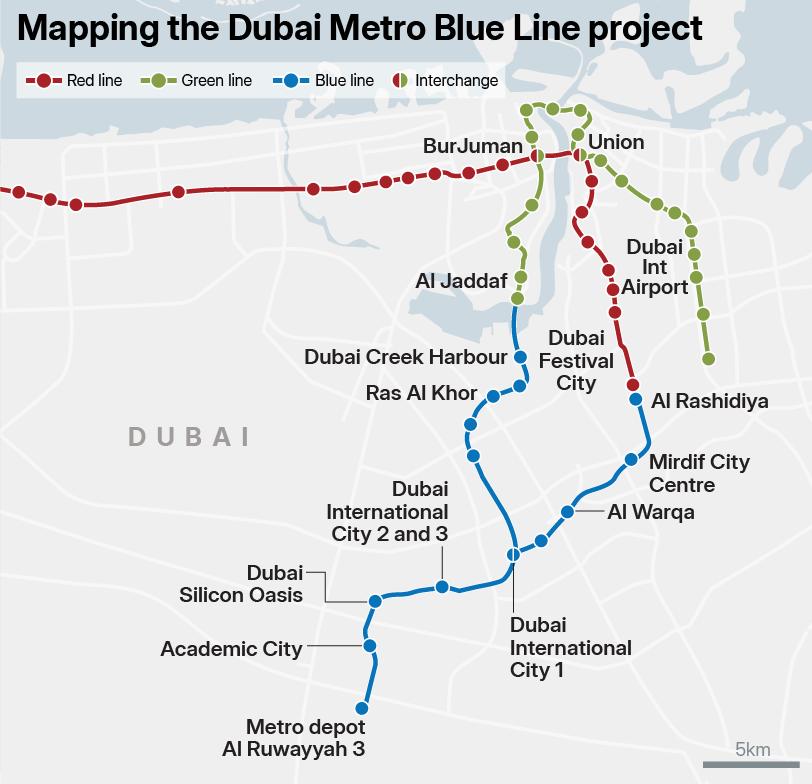
THE DUBAI METRO BLUE LINE
The Blue Line is planned to cover approximately 30 kilometres and include 14 stations. Its route will connect areas including Dubai Creek Harbour, International City, Dubai Silicon Oasis, Academic City, Mirdif and Al Warqa.
The Roads and Transport Authority (RTA) has targeted the line’s opening for 9 September 2029.
For investors, the important consideration is how the new connections may affect accessibility in communities that have historically relied more heavily on road transport.
Areas gaining direct metro access for the first time could become more attractive to residents who want additional commuting options. Nevertheless, the actual effect will vary by neighbourhood and property. https://www.rta.ae/wps/portal/rta/ae/home/news-and-media/AllProjects/ongoing-project-details/dubai-metro-blue-line?utm_source=chatgpt.com
THE DUBAI METRO GOLD LINE
In April 2026, Dubai approved the Gold Line, a planned 42-kilometre underground metro line with 18 stations. The route is designed to connect with the Red and Green Lines and integrate with Etihad Rail.
The RTA has announced a planned inauguration date of 9 September 2032.
Although the project may create longer-term investment opportunities, buyers should distinguish between an approved infrastructure project and an operational metro service. Property owners may need to wait years before residents can use the new connections.
Investors should therefore evaluate whether the purchase price reflects the current location or relies heavily on anticipated future infrastructure.
HOW CLOSE SHOULD A PROPERTY BE TO A METRO STATION?
Distance matters, but the shortest distance does not always indicate the best investment.
A property within a comfortable walking distance may offer convenient access. However, the route to the station also matters. Safe pedestrian paths, shaded walkways, road crossings and access during Dubai’s hotter months can influence how practical the journey feels.
A property that appears close on a map may still require a lengthy or inconvenient walk.
Before buying, consider these questions:
- How long does it actually take to walk to the station?
- Is the route safe and practical throughout the year?
- Does the station connect directly to relevant employment and lifestyle destinations?
- Are shops, schools and other everyday amenities nearby?
- Does the property offer other advantages beyond metro access?
A well-connected community with useful amenities may have stronger long-term appeal than a property that relies on one transport link alone.
DOES A NEW METRO STATION GUARANTEE HIGHER RENTAL YIELDS?
No. Better transport access can support rental demand, but it does not guarantee higher yields or stronger returns.
Rental yield depends on both rental income and the purchase price. If property prices rise before rents, an investor’s yield may remain unchanged or even decline.
For example, consider two properties with different purchase prices and annual rents.
| Investment | Purchase price | Annual rent | Gross rental yield |
|---|---|---|---|
| Property A | AED 800,000 | AED 48,000 | 6% |
| Property B | AED 1,000,000 | AED 55,000 | 5.5% |
Property B earns more rent in absolute terms. However, Property A offers the higher gross rental yield because its purchase price is lower relative to its annual rent.
These figures are illustrative. They demonstrate why investors should compare both the rental potential and the total acquisition cost rather than focus only on the location.
Service charges, maintenance, vacancy periods and property management fees will also affect the net return.
WHAT SHOULD INVESTORS CHECK BEFORE BUYING NEAR A PLANNED METRO STATION?
Buying ahead of infrastructure improvements can offer potential advantages, but it also introduces uncertainty.
Before committing, investors should evaluate the following factors.
CONFIRM THE PROJECT STATUS. Check whether the station is officially announced, approved, under construction or already operational. Do not rely solely on marketing material or informal claims about future stations.
REVIEW THE TIMELINE. Construction schedules can change. Consider whether you can hold the property if the station opens later than expected.
COMPARE CURRENT PROPERTY PRICES. If sellers already charge a premium because of the planned station, some of the anticipated benefit may already be reflected in the price.
ASSESS RENTAL FUNDAMENTALS. Look at comparable rents, vacancy rates, tenant demand and competing developments in the area.
EVALUATE THE WIDER COMMUNITY. Access to transport is valuable, but property quality, amenities, employment opportunities and neighbourhood appeal also influence demand.
CALCULATE CONSERVATIVE RETURNS. Test whether the investment remains financially viable if rents grow more slowly than expected or resale prices remain flat.
THE RISKS OF INVESTING BASED ON FUTURE INFRASTRUCTURE
One of the biggest mistakes investors can make is assuming that a planned metro station will automatically deliver capital appreciation.
Infrastructure can improve accessibility, but property performance also depends on economic conditions, housing supply, buyer sentiment and the price paid.
Furthermore, a new station may benefit one part of a neighbourhood more than another. Properties with convenient walking access may appeal differently from those that still require a car or feeder bus.
There is also a timing risk. Investors who buy years before a station opens may face ongoing ownership costs while waiting for the anticipated benefit to materialise.
For this reason, a planned metro connection should strengthen an investment case, not serve as the only reason to buy.
FINAL THOUGHTS: CAN A METRO STATION CHANGE A PROPERTY’S APPEAL?
Yes, a new Dubai Metro station can make a property more appealing by improving connectivity, expanding commuting options and potentially attracting more tenants and buyers.
Dubai’s planned Blue and Gold Lines create reasons for investors to examine communities that may benefit from future transport connections. However, the strongest opportunities will depend on the specific location, the property’s price, rental fundamentals and the actual delivery of infrastructure.
The key is to look beyond the station itself. Consider how the transport link changes daily life, whether tenants will value the convenience and whether the purchase price leaves room for a reasonable return.
For property investors, metro access is worth considering, but the best investment decisions combine connectivity with realistic financial analysis and an understanding of the wider community.